The Plasma Science and Fusion Center (PSFC) has partnered with the University of California, San Diego (UCSD) and the University of California, Berkeley to create a new Center for the study of Plasma Surface Interactions (PSI). Funded by the Office of Fusion Energy Sciences, the PSI Center will receive $6.9 million over five years, with the PSFC receiving about one third.
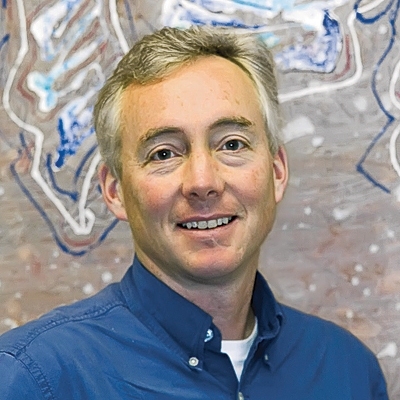
Professor Dennis Whyte, PSFC Principal Investigator for the PSI Center, has long been interested in how particles at the edge of a plasma behave, and how they affect the wall materials of their confinement vessels, such as tokamaks used in fusion research. Whyte notes, "The demands on plasma-facing materials in a steady-state fusion device will be extreme." Some materials might erode or degrade quickly, requiring frequent replacement; others might eject too much material into the plasma, contaminating it. Finding answers to questions about the physics of plasma interactions at this boundary could affect future choices in fusion engineering.
At the PSFC, PSI experiments will be performed using DIONISOS, a unique combination of an accelerator with a high-power laboratory plasma, which Whyte originally developed at the University of Wisconsin-Madison before coming to MIT. This experiment uses a steerable high-energy ion beam to analyze in real time materials being bombarded by plasma.
Within the tripod structure of the PSI Center, the PSFC will be responsible primarily for measurements and diagnostics. The UCSD Center for Energy Research will perform experiments that expose materials to plasma, while UC Berkeley Department of Nuclear Engineering will focus on numerical modeling of the materials.
Scientific ideas generated by the PSI Center, from work on DIONISOS, PISCES (at UCSD) and other experiments, will be tested in the fusion environment of tokamaks: Alcator C-Mod at MIT and DIII-D at General Atomics. But the research has applications beyond fusion; the PSI Center also plans to work on plasma thrusters for space travel.
Professor Dennis Whyte, PSFC Principal Investigator for the PSI Center, has long been interested in how particles at the edge of a plasma behave, and how they affect the wall materials of their confinement vessels, such as tokamaks used in fusion research. Whyte notes, "The demands on plasma-facing materials in a steady-state fusion device will be extreme." Some materials might erode or degrade quickly, requiring frequent replacement; others might eject too much material into the plasma, contaminating it. Finding answers to questions about the physics of plasma interactions at this boundary could affect future choices in fusion engineering.
At the PSFC, PSI experiments will be performed using DIONISOS, a unique combination of an accelerator with a high-power laboratory plasma, which Whyte originally developed at the University of Wisconsin-Madison before coming to MIT. This experiment uses a steerable high-energy ion beam to analyze in real time materials being bombarded by plasma.
Within the tripod structure of the PSI Center, the PSFC will be responsible primarily for measurements and diagnostics. The UCSD Center for Energy Research will perform experiments that expose materials to plasma, while UC Berkeley Department of Nuclear Engineering will focus on numerical modeling of the materials.
Scientific ideas generated by the PSI Center, from work on DIONISOS, PISCES (at UCSD) and other experiments, will be tested in the fusion environment of tokamaks: Alcator C-Mod at MIT and DIII-D at General Atomics. But the research has applications beyond fusion; the PSI Center also plans to work on plasma thrusters for space travel.