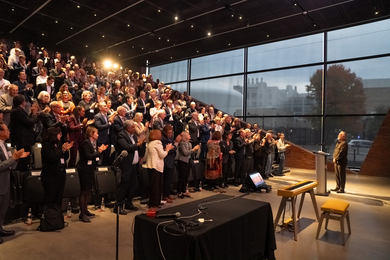
Professor Loren Graham weighed the economic, political and intellectual aspects of the challenges confronting Russian science in the George Sarton Award Lecture in the History and Philosophy of Science on Feb. 15 at the national meeting of the AAAS.
Graham, a professor of the history of science whose talk was titled "Russian Basic Science: Changes Since the Collapse of the Soviet Union and the Impact of International Support," also focused on the role of both private foundations and of the US Civilian Research and Development Foundation.
The story of Russian science since the advent of Gorbachev in 1995 through the collapse of the former Soviet Union and up to today is a dramatic one, but the details of that story are poorly known, even in Russia.
As the outlines of the recent past are hazy, so are those of the future; the organization and financing of Russian science are still in flux. Yet predictions of the death of Russian science were wrong, and signs of evolutionary--not revolutionary--recovery are evident today.
"The old system has been sharply criticized. It appears more and more likely that Russia will develop an organizational framework for fundamental science that resembles foreign models a bit more than the Soviet pattern did, but remains distinctly different. Cooperation between the universities and the Russian Academy of Sciences is emerging as an important trend," said Graham.
A version of this article appeared in MIT Tech Talk on February 27, 2002.