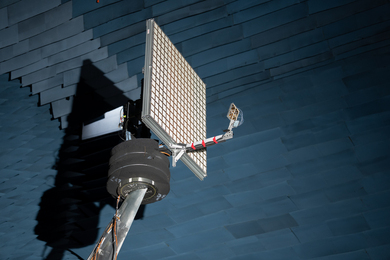
Antenna array could provide protected tactical satellite communications in low-Earth orbit
The prototype array uses a small, lightweight, low-power, and low-cost aperture.
The prototype array uses a small, lightweight, low-power, and low-cost aperture.

By analyzing X-ray reverberations and other astrophysical data, Erin Kara seeks to understand the most extreme objects in the universe.
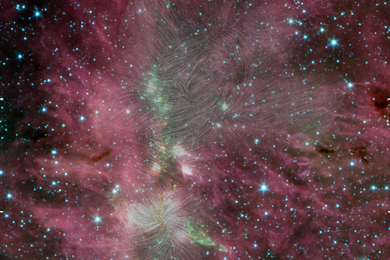
MIT Haystack Observatory researchers use SOFIA observations to reveal how magnetic fields guide the assembly of one of our galaxy's most active high-mass star-forming regions.

As the international program approaches its 60th year, leaders are reshaping its curriculum to address emerging technologies and the policies shaping their use in urban planning.
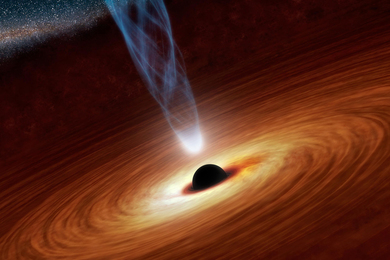
When the universe was just 850 million years old, this voracious black hole was already surprisingly mature, a new study finds.
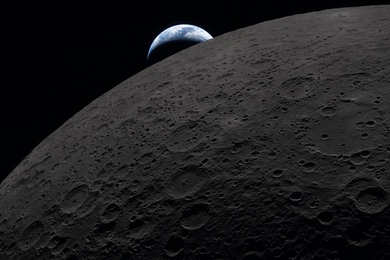
This first use of laser communications on a crewed mission at lunar distance was a foundational step to establishing a high-speed internet in deep space.
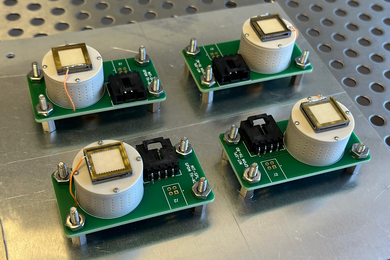
For satellites as small as a briefcase, getting around in space just got a whole lot easier.
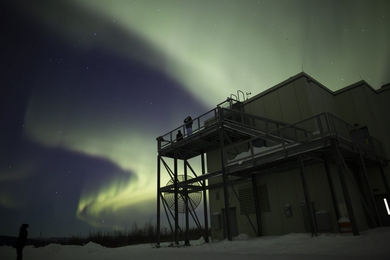
Student-led expeditions use distributed instruments to observe auroral structures and probe space plasma in real-world conditions.
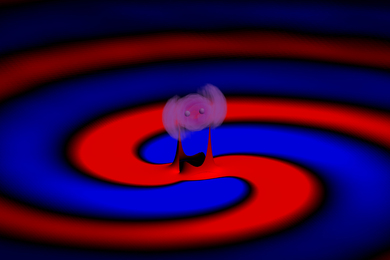
Gravitational waves emitted by colliding black holes may bear imprints of dark matter, which physicists could detect with a new model.
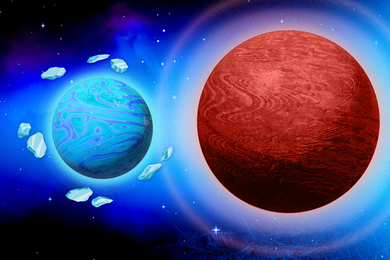
New measurements of a hot Jupiter and its mini-Neptune companion suggest both planets formed surprisingly far away from their host star.
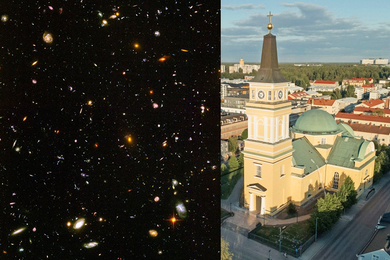
An immersive sound installation at Oulu Cathedral, Finland, co-created by MIT Associate Professor Kiyoshi Masui, transforms more than 4,000 cosmic signals into spatial audio.

Associate Professor Richard Linares is helping satellites safely navigate in increasingly congested orbits.

From lazy ripples to towering breakers, waves should vary widely from one planet to another, according to a new model.
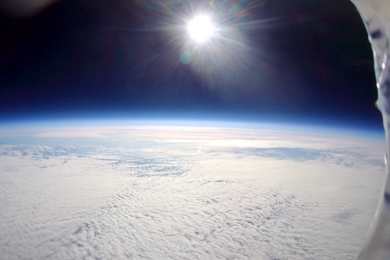
MIT students see the Earth's curvature in reborn AeroAstro intro course.
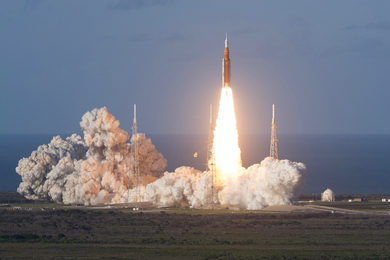
High-definition video and data sent from the lunar vicinity to Earth will demonstrate the first use of laser communications on a crewed mission.