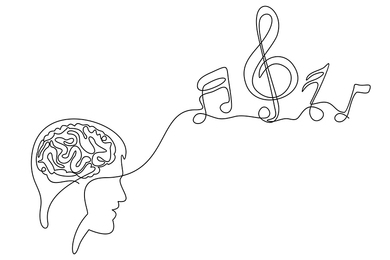
Study sheds light on musicians’ enhanced attention
Brain imaging suggests people with musical training may be better than others at filtering out distracting sounds.
Brain imaging suggests people with musical training may be better than others at filtering out distracting sounds.
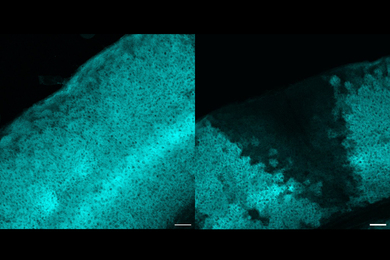
MIT researchers employed a novel application of tools and analysis to show that astrocytes ensure neural information processing by maintaining ambient levels of the neurotransmitter chemical GABA.

As an object moves across your field of view, the brain seamlessly hands off visual processing from one hemisphere to the other like cell phone towers or relay racers do, a new MIT study shows.
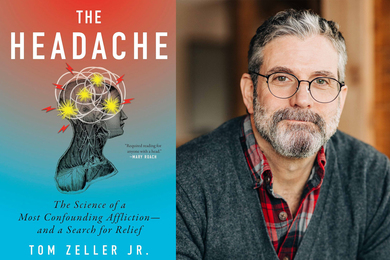
Tom Zeller’s new book, “The Headache,” sheds light on one of the world’s most confounding and agonizing ailments.
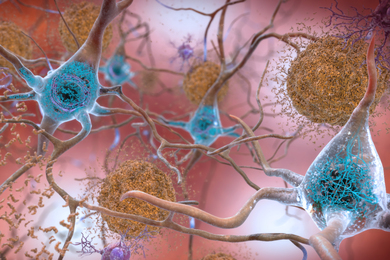
Lipid metabolism and cell membrane function can be disrupted in the neurons of people who carry rare variants of ABCA7.
Study of 3.5 million cells from more than 100 human brains finds Alzheimer’s progression — and resilience to disease — depends on preserving epigenomic stability.
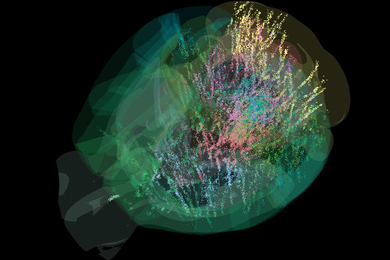
An international collaboration of neuroscientists, including MIT Professor Ila Fiete, developed a brain-wide map of decision-making at cellular resolution in mice.
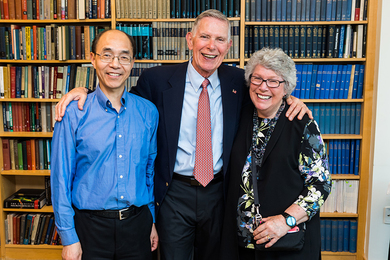
A commitment from longtime supporters Patricia and James Poitras ’63 initiates multidisciplinary efforts to understand and treat complex psychiatric disorders.
Tools build on years of research at Lincoln Laboratory to develop a rapid brain health screening capability and may also be applicable to civilian settings such as sporting events and medical offices.
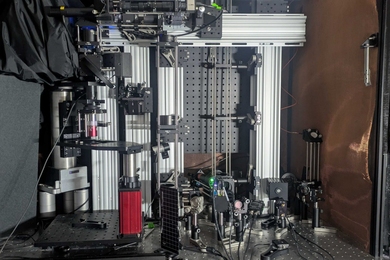
By combining several cutting-edge imaging technologies, a new microscope system could enable unprecedentedly deep and precise visualization of metabolic and neuronal activity, potentially even in humans.

A new computational model makes sense of the cognitive processes humans use to evaluate punishment.

A first-of-its-kind study in mice shows neurons add and shed synapses at a frenzied pace during development to integrate visual signals from the two eyes.

With an emphasis on approachability, Professor Mark Bear’s “Neuroscience: Exploring the Brain” enters its fourth decade as the text of undergraduate neuroscience classes worldwide.

FutureHouse, co-founded by Sam Rodriques PhD ’19, has developed AI agents to automate key steps on the path toward scientific progress.
Study shows humans flexibly deploy different reasoning strategies to tackle challenging mental tasks — offering insights for building machines that think more like us.