Skip to content ↓

📬 Want a dose of MIT in your inbox? Subscribe to the MIT Daily and/or MIT Weekly newsletters.

Top News

Looking for audio? Listen to the MIT News podcast →

Recent Highlights

More MIT News articles

In the Media

The Boston Globe

For The Boston Globe, reporter Hope Reese spotlights Prof. Sherry Turkle’s latest book “Artificial Intimacy: Who We Become When We Talk to Machines,” which explores the impact of relationships between humans and AI chatbots. “Chatbots are programmed to keep us engaged; that’s why they soothe us and validate us and confirm our beliefs. But that’s not the sort of relationship we’re built for,” writes Reese. “We’re meant to encounter obstacles, friction, tension –– which leads us to learn more about ourselves and each other and to develop resilience.” 

Smithsonian Magazine

MIT researchers have invented a digestible, bioresorbable battery that can deliver drugs directly to the GI tract, reports Smithsonian Magazine’s Sara Hashemi. Prof. Giovanni Traverso and his colleagues “made two versions of the battery of different sizes and voltages,” writes Hashemi. “Exposing them to an acidic liquid similar to gastric fluid revealed they would function normally in the stomach for about three days.” 

MassLive

MIT was listed as the No. 1 national university in U.S. News & World Report’s 2027 “Best Colleges Rankings,” “based upon the analysis of more than 1,700 colleges and universities nationwide across 17 key measures,” writes MassLive’s Claudia Dimuro. “These measures included ‘First-year retention rates,’ ‘Earnings by major,’ ‘Faculty salaries,’ and ‘Student-faculty ratio,’ notes Dimuro.  

The Boston Globe

In an opinion piece for The Boston Globe, Prof. Jonathan Gruber discusses Massachusetts’ Question 5, the proposed tax rebate rule that would mandate that taxes be returned to taxpayers each time the state’s revenues grow faster than wages and salaries. “Most economists believe a recession is coming but we can’t say when. The best way to plan is to have the savings to help us through, or to invest so that we are as strong as possible when it hits,” writes Gruber. “Question 5 chooses the third path — spending the money now, and letting the state suffer in the future.”  

Tech Briefs

Hamid Doosthosseini PhD ‘25, an MIT postdoc, speaks to Tech Brief’s Andrew Corselli about his team’s work engineering bacteria to act as transistors on “living circuit boards.” “Simply, each cell works somewhat like a traffic light at an intersection, it determines whether traffic (here a chemical signal) should continue or stop based on traffic in the intersecting road,” says Doosthosseini. “Printing a network of cells can therefore combine, compute, or direct signals.” 

Bloomberg

Prof. David Autor and his team of researchers found that junior patent attorneys who used AI for assistance showed no net improvement in their skills, reports Andy Mukherjee for Bloomberg. “When researchers subsequently tested everyone on an unassisted, offline task to gauge internalized judgment, the learning gains went entirely to senior lawyers,” writes Mukherjee. “Foundational expertise may be a prerequisite for extracting durable skill from AI-assisted practice,” the researchers noted.  

Fortune

For Fortune, reporter Barry Werth highlights the groundbreaking research of the late Prof. David Baltimore, founding director of the Whitehead Institute at MIT, who “independently discovered an enzyme essential for the reproduction of retroviruses such as HIV, which spread by inserting their genes into the DNA of host cells and hijacking the cells’ chemical machinery to make copies of themselves.” “Few investigators were more qualified or better positioned to understand how to stop HIV from spreading,” writes Werth.  

GBH

Prof. Jonathan Gruber joins Edgar B. Herwick III, host of GBH’s “The Curiosity Desk” to discuss what factors into the U.S. Federal Reserve’s decision to raise interest rates for the first time since 2023. Federal Reserve members “are looking at things like tariffs, the tax on goods coming into this country. They’re looking at the war,” says Gruber. “We have, basically, these underlying forces driving inflation. In that case, the Fed has a mandate. The Fed’s job is to balance two forces: economic growth and inflation, and the way they balance them is by trying to keep inflation near a target of two percent.”  

The 74

Prof. Justin Reich, director of the MIT Teaching Systems Lab, speaks to The 74’s Greg Toppo about the risk of students using AI teaching tools to cheat on their assignments. “There's a zillion people that are trying to come up with these guided learning environments and Socratic tutors and stuff like that,” says Reich. “And I'm just like, 'Guys, you're putting the "Carefully teach me this stuff" button directly next to the "Do everything for me" button.’”  

Chalkbeat

Prof. Justin Reich, director of the MIT Teaching Systems Lab, speaks to Chalkbeat’s Lily Altavena about the need for policymakers to develop stronger guidelines to help teachers address the misuse of AI in their classrooms. “I think the situation teachers are in [without AI policies] feels bad, and feels like they ought to have a solution now that they don’t have,” says Reich. Existing documents on academic integrity “seem light on actual guidance and don’t include many citations, Reich said.”  

Community Updates

Featured Multimedia

Video thumbnail

Drawing on research he began at MIT, AJ Perez ’13, MEng ’14, PhD ’23, is finding new uses for the world’s growing plastic waste. His company, Atlas, 3D prints building materials from recycled plastic, giving discarded material a new purpose.

Video thumbnail

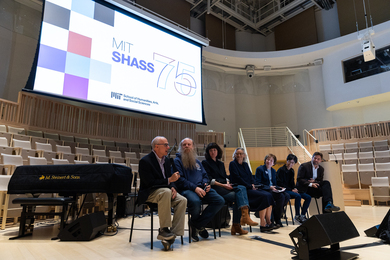
Founded in 1950, MIT’s School of Humanities, Arts, and Social Sciences encourages students to think broadly about the world and their place in it, while examining what it means to be human and the social, ethical, and economic dimensions of today’s greatest challenges.

Video thumbnail

A fast-paced look at the people, ideas, research, and experiences that make MIT what it is. From groundbreaking discoveries and hands-on learning to a vibrant campus community, see the curiosity, creativity, and innovation that drive the Institute. This is MIT.

Video thumbnail

Meet Paula Hammond, MIT Institute Professor and Dean of the School of Engineering—the first woman and first Black scholar to lead MIT's Department of Chemical Engineering. Discover how her pioneering research in nanotechnology and ovarian cancer has shaped her career, the barriers she broke along the way, and what it means to change what leadership looks like in STEM.

Video thumbnail

What if operating an excavator could be faster, easier, and more intuitive? MIT engineers have developed a new controller designed to make digging simpler—and help train operators faster. See how this new technology could change the way we dig.

Video thumbnail

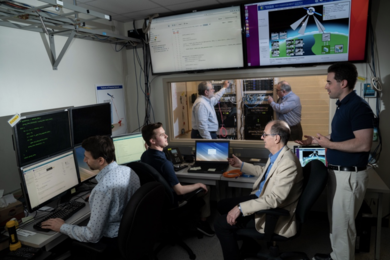
For 75 years, MIT Lincoln Laboratory has developed technology to help keep the nation safe. Founded in 1951, the Laboratory tackles critical national security challenges through long-term research, rapid system prototyping, and demonstration. It also works with industry to transition new concepts and technologies into systems ready for development and deployment.

More News