Skip to content ↓

📬 Want a dose of MIT in your inbox? Subscribe to the MIT Daily and/or MIT Weekly newsletters.

Top News

Looking for audio? Listen to the MIT News podcast

Recent Highlights

More MIT News articles

In the Media

Chronicle

Chronicle reporter Jon Rineman spotlights Prof. Li-Huei Tsai’s work researching how stimulation via light and sound could one day potentially be used to help fight Alzheimer’s disease. “People who continued with this treatment, their memory capacity really has been maintained at a steady state level,” explains Tsai. “And in a couple of patients, their Alzheimer’s biomarkers actually significantly reduced.” 

CNN

Using the James Webb Space Telescope (JWST), astronomers from MIT and other institutions have determined that asteroid 2024 YR4 will not collide with the moon, reports Ashley Strickland for CNN. “Every time we observe an asteroid, we reduce the range of possible trajectories,” explains Prof. Julien de Wit. “In this case, the JWST observations both provided very precise positional measurements and significantly extended the time span over which the asteroid has been observed.”

MassLive

MIT has launched a new effort aimed at helping high schoolers across the U.S. tackle calculus, reports Juliet Schulman-Hall for MassLive. The new program, called the MIT4America Calculus Project, pairs trained MIT undergraduates and alumni with school districts across the U.S. to tutor high school students from Montana to Texas in calculus. The program “was created last year with an in-person summer calculus camp,” Schulman-Hall notes. “Since then, it has grown to include 14 school districts.” 

The Boston Globe

Boston Globe reporter Kate Tuttle spotlights “We (The People of the United States),” a new poetry book by Prof. Joshua Bennett. “I started to think of it as an ode to invention,” says Bennett. “There are poems in the book about individual people, but there are also poems about the television, the typewriter, the trampoline. I really wanted to celebrate the invention of a people, the invention of a country, the invention of a certain vision of the human genre.”

New York Times

Prof. Christopher Knittel speaks with New York Times reporter Emmett Lindner about how the conflict with Iran has influenced gas prices in the United States. “When there’s a supply disruption in the Middle East, that raises prices for every barrel of oil in the world,” explains Knittel. “Those price increases then trickle down to products that use oil, gasoline being the most relevant one.”

NPR

A new essay by Profs. Daron Acemoglu, David Autor and Simon Johnson, has offered “a more hopeful vision for the future of human work,” in a world infused with AI, reports Greg Rosalsky for NPR’s Planet Money. The authors “spend much of the essay providing a thought-provoking analysis of how new technologies can affect human jobs in general,” writes Rosalsky. “In short, it's complicated. Yes, often they do kill jobs. Other times they can make jobs less lucrative by, for example, making those jobs easier to do — or ‘de-skilling’ them — which means the supply of workers who can do these jobs goes up and wages for the occupation can go down.” 

Associated Press

Prof. Simon Johnson speaks with Associated Press reporter Paul Wiseman about how the conflict with Iran has impacted the global economy. “The Strait of Hormuz has to be reopened,” says Johnson. “It’s 20 million barrels of oil a day going through there. There’s no excess capacity anywhere in the world that can fill that gap.” 

Vogue

Vogue editor Lisa Wong Macabasco spotlights “Lighten Up! On Biology and Time,” a new exhibit at the MIT Museum that “traces the rhythms of life itself: circadian patterns, light’s command over the body, and the delicate architecture of alertness and rest.” The exhibit features “18 works that blend science and art, from immersive soundscapes to visualizations of circadian patterns and reflective spaces where you observe your own heartbeat and alertness in new ways,” explains Macabasco. 

WBUR

Prof. Alessandro Acquisti speaks with WBUR reporters Woodrow Hartzog and Neil Richards about privacy concerns surrounding consumer data. “The online advertising industry has long extolled the benefits of targeted advertising, presenting it as an economic win-win for publishers, merchants and consumers alike,” says Acquisti. “And yet, in reality, there is little robust empirical evidence that any stakeholder – other than the data intermediaries themselves – actually benefit from this type of advertising.” 

CNBC

A study by Prof. Taha Choukhmane and his colleagues has found that “by switching retirement contributions to the account with the higher match rate, 1 in 5 couples could increase their savings by an estimated $750 per year,” reports Lorie Konish for CNBC. “The absence of coordination can be a choice, but it’s a costly choice,” says Choukhmane. 

Times Higher Education

Times Higher Education features President Sally Kornbluth among the world’s top 10 universities led by women in 2026, reports Patrick Jack for Times Higher Education. “Of the top 200 institutions in the Times Higher Education World University Rankings 2026, 58 have a female vice-chancellor or president – 29 per cent of the total,” writes Jack. 

The Boston Globe

In an opinion piece for The Boston Globe, MIT Prof. Carlo Ratti and University of Toronto Prof. Richard Florida explore the “paradox of overtourism.” Ratti and Florida note that: “Tourism accelerates global convergence — the same luxury retailers, hotel chains, and Instagram‑ready design cues that push cities to conform to international expectations. At times, it can even undermine more authentic local businesses, which cannot compete against much larger global competitors. Yet local distinctiveness does not vanish under global pressure; it adapts. The visual signatures that make one place different from another persist beneath the surface layer of brands. That is where efforts to manage tourism’s cultural impact should concentrate.” 

Community Updates

Featured Multimedia

Video thumbnail

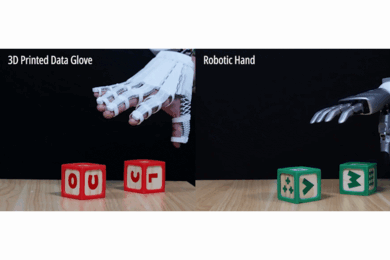
Joseph Paradiso of the MIT Media Lab advances wearable sensing technologies that translate human motion into data and sound, shaping research across dance, medicine, exploration, and human-technology interaction. His work has influenced fields from dance and sports medicine to environmental research and exploration.

Video thumbnail

MIT Lincoln Laboratory’s Communication Networks and Analysis Group develops resilient communication technologies that enable secure, seamless data sharing across space, air, and surface platforms—even in contested or congested environments.

Video thumbnail

MIT President Sally Kornbluth speaks with Associate Professor Emil Verner who examines how finance and the broader economy interact. In this episode they talk about why financial crises happen, how they ripple through economies and politics, and what they mean for individual financial stability.

Video thumbnail

In 16.85 Autonomy Capstone (Design and Testing of Autonomous Vehicles), AeroAstro students build software that allows autonomous flight vehicles to navigate unknown environments. Students develop software and hardware for a quad-rotor drone, navigating a challenging obstacle course. The course emphasizes systems-level thinking and real-world applications.

Video thumbnail

At MIT, our mission is to advance knowledge; to educate students in science, engineering, technology, humanities and social sciences; and to tackle the most pressing problems facing the world today. We are a community of hands-on problem-solvers in love with fundamental science and eager to make the world a better place.

Video thumbnail

Justin Kay's research focuses on making computer vision and machine learning systems more deployable and informative for science and decision-making, particularly for environmental and climate applications. Here he talks about AI and environmental conservation and answers some specific questions about his work.

More News