Skip to content ↓

📬 Want a dose of MIT in your inbox? Subscribe to the MIT Daily and/or MIT Weekly newsletters.

Top News

Looking for audio? Listen to the MIT News podcast →

Recent Highlights

More MIT News articles

In the Media

New Scientist

Prof. Ore Gottlieb speaks to New Scientist’s Leah Crane about his team finding that if a primordial black hole fell into the center of a sun-like star, it would either consume gas until the last of the star’s material fell in (if the star was spinning slow) or become a parasite that would cause the star to explode (if the star was spinning fast). “What is really exciting is that previously this process was not predicted to produce any type of explosion or observational signature,” says Gottlieb. “But now we know that if these types of systems exist in nature, we have a way to find them.” 

Financial Times

In an article by Financial Times reporter Andrew Jack, Senior Lecturer Renée Gosline discusses implementing good friction in the workplace. Gosline notes that good friction “can include measures such as two-factor authentication to reduce online scams,” and warns against “uncritical adoption of AI,” writes Jack.  “I have yet to go to a single executive group and hear people talk about friction as anything other than something to be eradicated,” says Gosline. “But it’s been misused quite heavily as synonymous with a pain point.” 

Los Angeles Times

Research Scientist Paul Kedrosky speaks to Los Angeles Times reporter Michael Hiltzik about how deferred maintenance of the world’s software likely contributed to the recent series of tech outages “The world’s enormous installed base of software, much of it old, poorly maintained, and deeply interconnected, is a soft target,” says Kedrosky.  

Nature

Nature’s Eli P. Fenichel, Lint Barrage and Robert J. Gordon spotlight the life and legacy of the late William D. Nordhaus PhD ‘67, “an economist known for introducing climate change into economic analysis, earning him the 2018 Nobel Prize in Economic Sciences.” Nordhaus “was driven by a desire for truth and discovery, with little concern for personal recognition. His approach to life was as balanced as his scholarship,” they write. “He cared deeply for the future of humanity and the ability of science to help to deliver a better future.”  

Forbes

The origin of Mes°, a new bio-designed haircare brand by Jasmina Aganovic ’09 and Jennifer Lawrence, actress and producer, is featured by Forbes’ Rachel Burchfield. “We want to transform haircare through this lens of biology and seeing the hair as a different material, which means that we want to create new claims, new product experiences and new stories,” says Aganovic.  

Newsweek

MIT researchers have estimated that data center electricity demand resulted in “513 premature deaths associated with fine particulate matter, known as PM2.5, and another 137 with ozone, or smog, for a combined total of 650 in 2023,” writes Newsweek’s Joe Edwards. “As demand [for data centers] continues to grow, these numbers will obviously go up (especially if connected to the grid, as it will become more stressed),” says Prof. Noelle Selin. “A lot of data centers are now building their own power (not connected to the grid). These will obviously affect air pollution and will be co-located with the data centers, so might enhance local impacts as well as those relatively far from the source.” 

The New York Times

For The New York Times’ “Unknowns” series, reporter Bill Wasik asked 100 scientists, including Professors David Kaiser, Linda Griffith, Joshua Tenenbaum, Robert Langer and Evelina Fedorenko, about the unsolved questions in their fields of research that excite their curiosity–from our understanding of human thought to creating virtual versions of human tissue and organs, and how children actually learn. Kaiser asks: “Is dark energy—which is causing the expansion of our universe to accelerate—a constant? Or is it changing over time?” Griffith inquires: “Where do endometriosis lesions come from, and why do only some women and girls develop them?” 

Tech Briefs

MIT researchers have developed the Uncertainty Quantification for Describe Anything, Anywhere, at Any Moment (UQ-DAAAM) system, that compares multiple descriptions of an object, seen from different viewpoints, to improve a robot’s object description accuracy and help the machine safely perform complex tasks in real-world environments, writes Andrew Corselli for Tech Briefs. “Robot perception is moving toward prediction and toward more predictive models, which is similar to how we humans operate,” says graduate student Nicolas Gorlo. “A lot of these internal signals that we get, like being surprised or learning on the go, are driven by a mismatch in what we predicted or what our internal model predicted and what we then observed.”  

Nature

Former Prof. George Whitesides, “a towering figure in chemistry who pushed chemists to cross boundaries to solve global problems,” has died at 87, reports Nature’s Lauren Wolf. At MIT, Whitesides studied the fundamentals of self-assembled monolayers (SAMs)1, “tightly packed coatings of organic compounds that are a single-molecule thick, formed spontaneously because of forces drawing the molecules to a surface and to one another,” writes Wolf. “From there, Whitesides saw ways of using SAMs to easily and cheaply create patterned surfaces. He would go on to invent soft lithography2, which instead uses polymer stamps to transfer micro- and nanoscopic patterns of molecules to surfaces.”  

Fortune

In an opinion piece for Fortune, Principal Research Scientist Neil Thompson and MIT FutureTech Strategic Partnerships Coordinator Damian Saccocio suggest that organizations should consider if an AI system will raise or lower wages before deploying it. “The lesson for all is to look past AI exposure,” Thompson and Saccocio write. “Capabilities matter, but business leaders in particular should judge AI by its full cost per task, including review and correction, not by demos. Policymakers should track AI’s cost and reliability, not just its capabilities. And workers and employers should ask which part of a job AI takes, because that decides whether the remaining work is worth more or less.”  

Community Updates

Featured Multimedia

Video thumbnail

The entirely student-run, self-taught and highly collaborative MIT Combat Robotics Club (CRC) builds high energy fighting machines to compete in House Battles and larger competitions. Students learn a variety of skills, from CAD and FEA to CNC Machining and Welding — and they learn through watching their creations get completely destroyed.

Video thumbnail

MIT quantum engineer Will Oliver joins President Sally Kornbluth to discuss the promise of quantum computing, the challenges of scaling the technology, and its potential to transform fields from drug discovery to materials science.
Video thumbnail

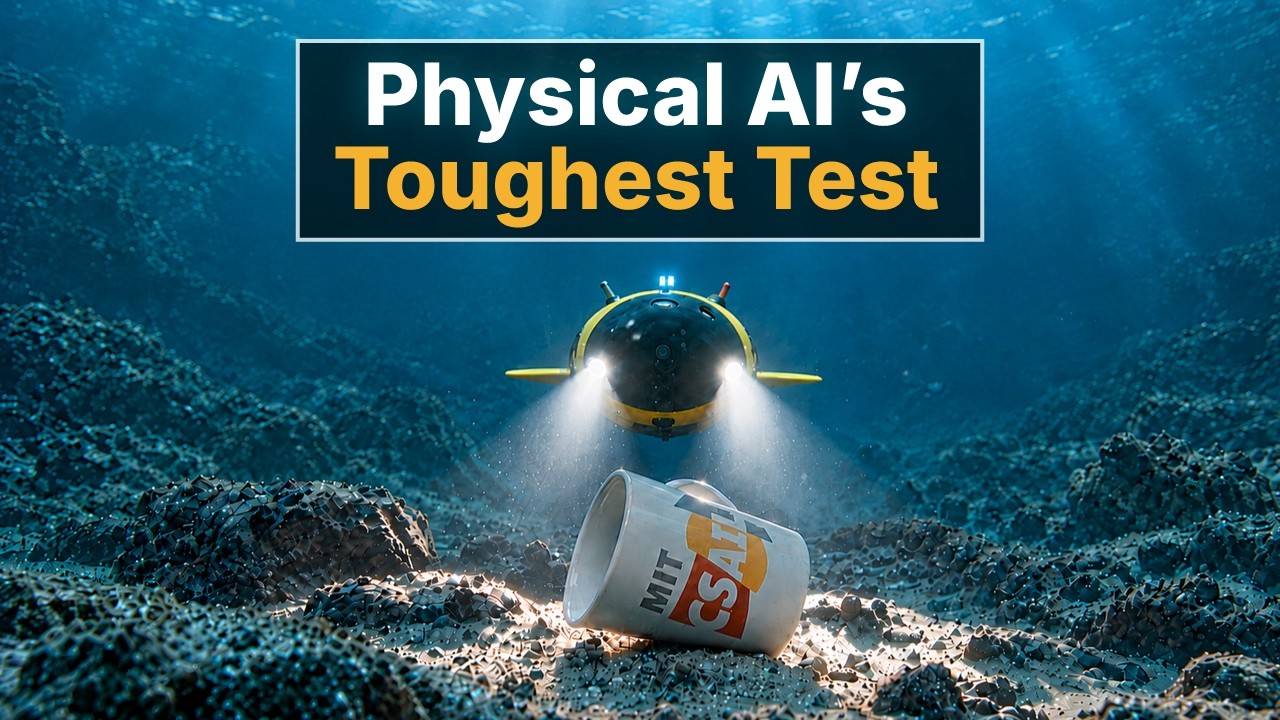
Exploring the ocean depths is one of AI’s toughest challenges—there’s no GPS, Wi-Fi, or clear visibility underwater. MIT CSAIL researchers are teaching autonomous robots to map murky seafloors using acoustic sonar, search in coordinated swarms, and master the physical dexterity needed to navigate uncharted waters.

Video thumbnail

What if solar panels could be lighter, thinner, and easier to install? MIT PhD student Karen Yang explores how developing flexible, lightweight solar technology could make clean energy more accessible, from remote communities and disaster relief efforts to rooftops that can't support traditional solar panels.

Video thumbnail

Alex Slocum, the Walter M. and A. Hazel May Professor of Mechanical Engineering at MIT, has a serious message for students in Fundamentals of Precision Product Design, but a famously fun way of delivering it. Students describe the course as “creative chaos,” an approach that drives home the importance of precision and repeatability in engineering design.

Video thumbnail

Quantum computers could revolutionize everything from drug discovery to cryptography, but building the hardware remains a challenge. MIT research scientist Patrick Strohbeen explores how studying materials at the nanoscale could help unlock the potential of quantum computing.

More News