Skip to content ↓

📬 Want a dose of MIT in your inbox? Subscribe to the MIT Daily and/or MIT Weekly newsletters.

Top News

Looking for audio? Listen to the MIT News podcast →

Recent Highlights

More MIT News articles

In the Media

Ars Technica

MIT researchers have developed Ataraxos, an AI system capable of winning the challenging game Stratego. The system could one day help decision makers with real-world problems that involve hidden information, reports Jacek Krywk for Ars Technica. “Board games have fixed rules and clear winners, while real-world problems like negotiations, financial markets, or military conflicts usually don’t,” writes Krywk. “But the Ataraxos team argues the gap is smaller than it looks, since tackling any real problem starts with building a simplified model of it.” 

The New York Times

A working paper by Prof. Drew Fudenberg and a team of researchers suggests that major AI companies should share their advances with one another to mitigate competitive pressures and decrease the potential of a catastrophic event, writes Amanda Taub for The New York Times. “If the players, including companies like OpenAI and Anthropic, can see that no one is racing into dangerous territory, they will have less motivation to do so themselves, the paper reasons,” explains Taub.  

The New York Times

Prof. Tyler Jacks, president of the nonprofit Break Through Cancer, speaks to The New York Times’ Gina Kolata about his research on resistance to the drug daraxonrasib in pancreatic cancer patients. “We all believe that daraxonrasib and other KRAS inhibitors are important initial steps [for treating pancreatic cancer],” says Jacks. In the future, the research will lead to, “one day, cures.” 

WBUR

Prof. Samuel Madden joins Tiziana Dearing, host of WBUR’s “Morning Edition,” to discuss the findings of MIT’s Ad Hoc Committee on AI Use in Teaching, Learning, and Research Training. “Cognitive surrender is the idea that people come to rely too heavily on these AI tools for their learning and they start outsourcing the critical thinking and the development of the foundational tools they think they need to succeed in life, to these AI tools,” says Madden. “It’s not just writing, but we see this [cognitive surrender] in our courses as well.”  

CNN

In a video interview, Prof. Turkle speaks to CNN’s Madeline Holcombe about how AI chatbots may contribute to feelings of loneliness and isolation in adults. “Technology offered the possibility of feeling like friendship without the demands of vulnerability,” says Turkle. “It turns out you can’t have intimacy or friendship without vulnerability.” 

San Francisco Chronicle

Prof. Sherry Turkle speaks to The San Francisco Chronicle’s Jessica Zack about the risks related to humans developing intimate relationships with AI chatbots, detailed in her book “Artificial Intimacy: Who We Become When We Talk to Machines.” “The experience of being with an object that uses the first person — the ‘I,’ and, even worse, the ‘we’— is problematic. We are evolved to think that if something talks to us that way, it is a person, so you’re fighting against your very deep evolutionary buttons that are being pushed,” says Turkle.  

Bloomberg

Prof. Gary Gensler joins Bloomberg’s “Open Interest” to discuss the risks AI poses to the financial system,. “We’re spending about 2.5% of our gross domestic product on this AI build,” says Gensler. “When we have these booms, they plateau at some point; firms lose some of their pricing power, some of their growth, and you expose where the debt in the system is. Right now, there’s a lot of risk in this capital market.”  

Slate

In a conversation with Slate’s Nitish Pahwa, Prof. Sherry Turkle discusses how to better bolster human connection and limit AI chatbot dependence, which she explores in her new book, “Artificial Intimacy: Who We Become When We Talk to Machines.” “We’re not going to solve this problem by manipulating the chatbots,” says Turkle. “We’re going to solve this problem by getting back together as us. We have to summon what we think is important about being people, both for ourselves and for our kids.”  

GBH

Prof. Dennis Whyte, co-founder of MIT spinoff Commonwealth Fusion Systems, joins GBH’s Hakeem Oluseyi, host of “Particles of Thought,” to discuss the future of fusion technology, which he describes as “the engine of the universe.” The energy power density of fusion “is about ten million times higher than gasoline,” says Whyte. “The cost and the accessibility to it [fusion] is not driven by access to fuel, but to the technology and the manufacturing capability of building the objects that would actually deliver fusion. We need a new discipline to tell us about what that is going to cost as a practical energy source—which we are starting to do now.”  

Bloomberg

Prof. Gary Gensler joins Tom Keene and Paul Sweeney, hosts of the “Bloomberg Surveillance Podcast” to discuss the impact of AI on the US fiscal market. “The AI trade that our capital market is hovering on top of is an investment boom that’s about twice what the internet was,” says Gensler. AI is “now about 2.5% of our economy—all of the data centers and so forth. [Major AI companies] are spending so much, but will it lead to the revenues to justify that spending?” 

Forbes

Forbes’ Afdhel Aziz highlights Extern, a platform that “helps students graduates and career switchers do real projects for companies,” founded by alumnus Matt Wilkerson ‘04, ‘05. “Nearly 90,000 people have used the platform to build experience they can put on a resume and talk about in an interview,” writes Aziz. “I want to work on a problem that really changes someone’s life in a very deep way, says Wilkerson.  

The New York Times

For The New York Times, reporter Jennifer Szalai reviews Prof. Sherry Turkle’s latest book, “Artificial Intimacy: Who We Become When We Talk to Machines,” about “the acceleration of human attempts to seek connection with chatbots.” “We have invited them [AI chatbots] not just into our homes but into some of the most private recesses of our emotional lives,” notes Szalai. “When people talk about how relaxing it is to talk to a chatbot, it’s because the real slips away,” writes Turkle in her book.  

Community Updates

Featured Multimedia

Video thumbnail

Alex Slocum, the Walter M. and A. Hazel May Professor of Mechanical Engineering at MIT, has a serious message for students in Fundamentals of Precision Product Design, but a famously fun way of delivering it. Students describe the course as “creative chaos,” an approach that drives home the importance of precision and repeatability in engineering design.

Video thumbnail

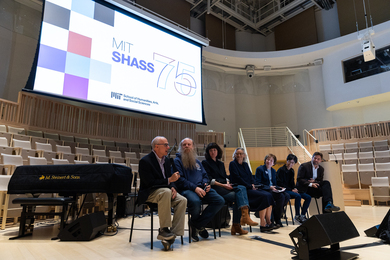
Founded in 1950, MIT’s School of Humanities, Arts, and Social Sciences encourages students to think broadly about the world and their place in it, while examining what it means to be human and the social, ethical, and economic dimensions of today’s greatest challenges.

Video thumbnail

Drawing on research he began at MIT, AJ Perez ’13, MEng ’14, PhD ’23, is finding new uses for the world’s growing plastic waste. His company, Atlas, 3D prints building materials from recycled plastic, giving discarded material a new purpose.

Video thumbnail

A fast-paced look at the people, ideas, research, and experiences that make MIT what it is. From groundbreaking discoveries and hands-on learning to a vibrant campus community, see the curiosity, creativity, and innovation that drive the Institute. This is MIT.

Video thumbnail

Meet Paula Hammond, MIT Institute Professor and Dean of the School of Engineering—the first woman and first Black scholar to lead MIT's Department of Chemical Engineering. Discover how her pioneering research in nanotechnology and ovarian cancer has shaped her career, the barriers she broke along the way, and what it means to change what leadership looks like in STEM.


More News