Skip to content ↓

📬 Want a dose of MIT in your inbox? Subscribe to the MIT Daily and/or MIT Weekly newsletters.

Top News

Looking for audio? Listen to the MIT News podcast

Recent Highlights

More MIT News articles

In the Media

Diabetics Doing Things

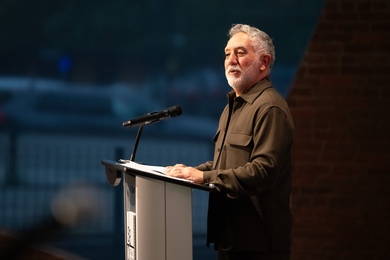
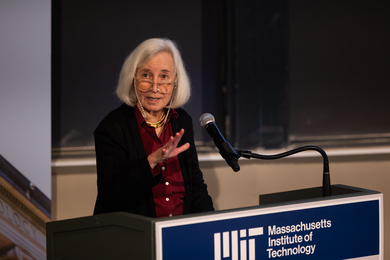
In an appearance on the national "Diabetics Doing Things" podcast, MIT President Sally Kornbluth and Johns Hopkins University President Ron Daniels discuss their experience as Type 1 diabetics, the importance of scientific research to diagnoses and treatments that have impacted millions of fellow Type 1 diabetics across the country, and the impact on their own lives of decades of advances made at leading research universities like theirs. In conversation with host Rob Howe, they reflect on the salience of standing up for the scientific enterprise. 

The Conversation

Writing for The Conversation, Research Scientist Judah Cohen and Mathew Barlow of UMass Lowell examine how the polar vortex and moisture from a warm Gulf of Mexico created a monster winter storm that brought freezing rain, sleet and snow to large parts of the U.S. “Some research suggests that even in a warming environment, cold events, while occurring less frequently, may still remain relatively severe in some locations. One factor may be increasing disruptions to the stratospheric polar vortex, which appear to be linked to the rapid warming of the Arctic with climate change,” they write. “A warmer environment also increases the likelihood that precipitation that would have fallen as snow in previous winters may now be more likely to fall as sleet and freezing rain.”

Inside Climate News

A new report by researchers from MIT’s Center for Sustainability Science and Strategy finds that the “world is on track to exceed key climate thresholds under current policies,” reports Ryan Krugman for Inside Climate News. The outlook is “based on MIT’s Integrated Global System Modeling framework, which links population growth, economic activity, energy use, and international policy decisions to changes in the global climate,” Krugman explains. “It’s not a reason to give up hope or stop the necessary action,” explains Sergey Paltsev, deputy director of the MIT Center for Sustainability Science and Strategy and a co-author of the report. “Limiting every degree possible matters, even every tenth of a degree.”

The Boston Globe

Writing for The Boston Globe, graduate student Jonah Prousky highlights the benefits and drawbacks of social media bans, and ways to protect kids from online harms. “We likewise need a cultural reckoning on screen time for kids, since heavy use is associated with anxiety, depression, attention fragmentation, and sleep deprivation,” writes Prousky. “Australia demonstrated that a law can be used to get the ball rolling.” 

WBUR

Prof. Christopher Palmer speaks with WBUR On Point host Meghna Chakrabarti about Americans and credit card debt, and how an interest rate cap could affect households across the country. “Anytime you have a price control, it has unintended consequences,” says Palmer. “Sometimes they're subtle. In this case, they're not subtle to see. We have lots of countries, lots of places where we've studied the effect of a cap on interest rates, and we see all sorts of unintended consequences.” 

Forbes

Forbes reporter Craig Smith spotlights Prof. Regina Barzilay for her work using her personal health experience to develop transformative medical technology. In response to her breast cancer diagnosis, Barzilay “developed a deep learning model that analyzes mammography images to predict breast cancer risk up to five years in advance,” writes Smith. 

GBH

GBH reporter Renuka Balakrishnan spotlights “True or False,” a game featured in the MIT Museum’s “AI: Mind the Gap” exhibit, which invites visitors to guess the difference between a real and deepfake video. The exhibit “provides tips visitors can use outside the walls of the museum to improve media literacy in real life,” writes Balakrishnan. 

Gizmodo

In an interview with Gizmodo reporter Ellyn Lapointe, Research Scientist Judah Cohen highlights his work understanding the “complex relationship between global climate change, polar vortex behavior, and extreme mid-latitude weather.” Cohen explains that: “In our research, we have demonstrated that polar vortex stretching events have accelerated in the era of accelerated Arctic change. Climate change in general, but Arctic change in particular, is favorable for forcing these events. 

The Boston Globe

Boston Globe reporter James Sullivan spotlights the annual MIT Mystery Hunt, “a weekend-long gaming tournament” dating back to 1981. “Created as a humble pastime for like-minded problem solvers, the hunt has grown into a multi-layered, internationally renowned competition, spawning dozens of imitators around the globe,” writes Sullivan. 

The Atlantic

Prof. Jonathan Gruber speaks with David Frum from The Atlantic’s “The David Frum Show” to shed light on the American healthcare system and health care disparities. “The issue in the U.S. is there are the haves and the have-nots—the haves get comparable health care to the rest of the world at a much higher price; the have-nots get worse health care at a much higher price,” says Gruber. “There’s really two fundamental challenges in U.S. health care: There’s disparities, and there’s costs.” 

New Scientist

A new analysis conducted by postdoctoral associate Rohan Naidu and his colleagues has found evidence that suggests “little red dot” galaxies may contain baby black holes, reports Alex Wilkins for New Scientist. “In ordinary black holes, what you actually see with your eyes is the tip of the iceberg of the total energy that is coming out of the system, but the little red dots we now understand should really be thought of as these puffed-up black hole stars,” says Naidu. “It seems that most of their energy is coming out at these wavelengths that we see with our eyes, so what you see is what you get.” 

CNBC

Prof. Jonathan Parker speaks with CNBC reporter Kate Dore about how larger tax refunds in 2026 could increase both consumer spending and inflation. “It could easily be inflationary,” says Parker.  

The Boston Globe

Brian Bergstein at The Boston Globe speaks with Bob Mumgaard SM '15, PhD '15, CEO of MIT spinout Commonwealth Fusion Systems, about the company’s efforts to advance fusion technologies.  “When the federal government said in 2012 that it would cut funding for the experimental fusion reactor on campus, the MIT researchers took that as an opportunity to develop new fusion techniques — which eventually formed the basis of CFS’s plans,” writes Bergstein. 

Community Updates

Featured Multimedia

Video thumbnail

Professor Jonathan Gruber speaks to classical economics being built on one powerful explanatory insight: that free markets — networks of buyers and sellers, producers and consumers, weighing the trade-offs of different options and making self-interested choices based on supply and demand — do a better job of deciding how to allocate resources than can be achieved by a top-down, command-economy approach.

Video thumbnail

The Edward and Joyce Linde Music Building is the new home for MIT Music. Fully opened in February 2025, the building provides a centralized facility for music instruction and performance, with top-quality rehearsal spaces, recording studios, and new labs for music technology.

Video thumbnail

The MIT Human Insight Collaborative (MITHIC) is a presidential initiative with a mission of elevating human-centered research and teaching and connecting scholars in the humanities, arts, and social sciences with colleagues across the Institute.

Video thumbnail

Associate professor of mechanical engineering, Sili Deng, is driving research in sustainable and efficient combustion technologies. Her research group targets three areas: building up fundamental knowledge on combustion processes and emissions; developing alternative fuels and metal combustion to replace fossil fuels; and flame-based synthesis of cathode materials for lithium-ion batteries.

Video thumbnail

At MIT, our mission is to advance knowledge; to educate students in science, engineering, technology, humanities and social sciences; and to tackle the most pressing problems facing the world today. We are a community of hands-on problem-solvers in love with fundamental science and eager to make the world a better place.

More News