Skip to content ↓

📬 Want a dose of MIT in your inbox? Subscribe to the MIT Daily and/or MIT Weekly newsletters.

Top News

Looking for audio? Listen to the MIT News podcast

Recent Highlights

More MIT News articles

In the Media

Nature

Prof. Regina Barzilay, graduate student Aziz Ayed and alumna Sydney Pham ‘24 are featured in an article about AI models and the workforce, written by Nature’s Ben Deighton. “Sometimes models can make sense of unexpected observations, which can guide further iterations of studies,” Pham says. “It’s helpful to understand how the models generate their results.” 

Hotel Mars

Postdoctoral Associate Rohan Naidu joins John Batchelor and David Livingston, hosts of the “Hotel Mars” podcast, to discuss his research discovering black hole stars from little red dots using NASA’s James Webb Space Telescope. “When we first discovered the little red dots, we assumed that red means dust, and so the idea was that the little red dots are the kind of black holes that we see in our backyard,” says Naidu. “But now we have this paradigm shift where we are realizing that red does not mean dust. Red could mean that you have this black hole star kind of object where all the blue light is being soaked up in this dense star-like cocoon.” 

Financial Times

Prof. Anna Stansbury speaks to the Financial Times’ Myles McCormick about a new study that found that chief executives at America’s largest low-wage employers had seen their pay rise 41 percent between 2019 and 2025, while the median worker earned 21 percent more income. “There’s been for several decades a shift in the balance of power from labor to capital in the US,” says Stansbury. “It seems unlikely that what’s happening now...can be used to infer a big secular shift in power beyond the ongoing steady trend that we’ve been seeing for a long time.”  

Popular Science

Graduate student Jaida Elcock speaks to Popular Science’s Laura Baisas about tagging a whale shark about 100 miles off the coast of New England, as part of an effort to learn more about the behavior of these giant sea creatures, in the biodiverse northeast canyon and seamounts region of the Northwest Atlantic Ocean. “There are whale shark aggregations all over the place. The Philippines, Mexico, Australia, tropical places like that. A lot of these aggregations are also often young individuals, subadult individuals, juveniles,” says Elcock. “Out in the [northeast] canyons, we’re seeing large adults.” 

The New York Times

Prof. Emeritus Kerry Emanuel speaks to The New York Times’ William J. Broad about the use of AI models in predicting hurricanes. “It’s human beings who have to make these calls,” says Emanuel. “[Eventually] AI will be treated as just another form of guidance” along with satellite images and readings from hurricane hunter aircraft that pierce the tempests. 

Forbes

MIT researchers found that purchased AI tools succeed roughly twice as often as comparable in-house builds, Forbes’ Dennis Vorobyov highlights. “[S]o spend the engineering effort where you are genuinely differentiated,” writes Vorobyov. “Budget wise, none of this requires a moonshot, just clarity and sequencing.” 

MassLive

MassLive’s Juliet Schulman-Hall covers a new report from the MIT Ad Hoc Committee on AI Use in Teaching, Learning and Research Training about AI and education at MIT. “It’s rare that a successful institution has to take a fresh look at many aspects of its mission,” said President Sally Kornbluth in a letter to the community. “But I’m convinced that the opportunities and risks generative AI poses for our model of education and research now constitute such a watershed for MIT — and for all of higher education.” 

Time Magazine

Prof. Daniela Rus, Director of MIT CSAIL, and Prof. David Autor, department head of Economics, are featured on Time’s “TIME100 AI 2026” list of 100 innovators, leaders, and thinkers reshaping the world through their advances in AI. “Over three decades, [Rus] has conducted pioneering work in robotics, extending the understanding of what form robots can take,” writes Tharin Pillay, while Steven Freiss describes Autor as “one of the nation’s most vocal and prominent economists aiming to ascertain AI’s potential impacts on labor.” 

Forbes

Writing for Forbes, Joseph Coughlin, Director of the MIT AgeLab, describes the importance of considering home security beyond simple intrusion protection in longevity planning. “A longevity-ready home to age-in-place isn't simply a safer, more accessible home,” writes Coughlin. “It is a home surrounded by an architecture of people, technology, and services that can detect, communicate, and respond even when we, or the people who care about us, cannot.” 

Financial Times

The Financial Times’ Anjana Ahuja spotlights research led by Prof. Dennis Whyte on the economics of fusion energy. “Economic Q, the metric devised by Whyte and others and which must exceed one to represent net economic gain, compares the capital gained over a fusion energy plant’s lifetime to that expended,” writes Ahuja. “Factors reflect the extreme engineering involved and include construction costs, component durability and the efficiency of converting fusion power into a commodity.” 

The Boston Globe

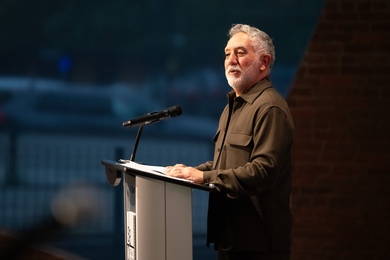
In conversation with The Boston Globe’s Hilary Burns, MIT President Emeritus L. Rafael Reif discusses his views on the value of US research universities and why saying so publicly matters. It's “tough times for universities, and that means a non-ending decline for the US,” warns Reif. “There is something unique about a university that companies do not have and national labs do not have, which is students. If we believe that science is important, we have to have a place where we create the scientists of the future.” 

Community Updates

Featured Multimedia

Video thumbnail

What if operating an excavator could be faster, easier, and more intuitive? MIT engineers have developed a new controller designed to make digging simpler—and help train operators faster. See how this new technology could change the way we dig.

Video thumbnail

Meet Paula Hammond, MIT Institute Professor and Dean of the School of Engineering—the first woman and first Black scholar to lead MIT's Department of Chemical Engineering. Discover how her pioneering research in nanotechnology and ovarian cancer has shaped her career, the barriers she broke along the way, and what it means to change what leadership looks like in STEM.

Video thumbnail

MIT researchers uncovered a new cyberattack that can bypass some of the latest security defenses built into modern computer processors. The researchers explain how the attack works — and what it reveals about potential vulnerabilities in today’s hardware.

Video thumbnail

MIT engineers have designed a robot that can fly through the air, dive underwater to swim, then flap back into flight—much like a diving bird. The breakthrough could pave the way for a new class of aerial-aquatic vehicles for ocean exploration.

Video thumbnail

For 75 years, MIT Lincoln Laboratory has developed technology to help keep the nation safe. Founded in 1951, the Laboratory tackles critical national security challenges through long-term research, rapid system prototyping, and demonstration. It also works with industry to transition new concepts and technologies into systems ready for development and deployment.

Video thumbnail

Researchers at MIT have developed injectable "mini livers" designed to temporarily take over essential liver functions, offering a potential new option for people with liver failure who are waiting for a transplant—or who aren't eligible for one at all.

More News