Skip to content ↓

📬 Want a dose of MIT in your inbox? Subscribe to the MIT Daily and/or MIT Weekly newsletters.

Top News

Looking for audio? Listen to the MIT News podcast

Recent Highlights

More MIT News articles

In the Media

Computer World

MIT researchers found the more data an AI model is trained on could complicate AI copyright, auditing, and governance, writes Computer World’s Taryn Plumb. “[S]ingle artworks by specific artists, or photographs of certain people, could be entirely removed from datasets, and the model could still reproduce that image or style,” writes Plumb. “Essentially, tangible connections are lost, and linking to specific data points responsible for generated samples is ‘practically impossible,’ or can even vanish, the researchers explained.” 

The Register

The Register’s Thomas Claburn highlights a new study by MIT researchers that found large AI models can still reproduce an artist’s style, even when the artist’s work is removed from its training data, making attribution more difficult. “[G]iven the contemporary adoption of these models for creative and commercial purposes, attributability also carries ethical, policy, financial, and legal implications,” the researchers note.  


Digital Trends

MIT researchers have discovered that when individual images are removed from large AI diffusion models, the models are still able to produce like images, writes Digital Trends’ Varun Mirchandani. “The more interesting takeaway is that this connection becomes increasingly difficult to trace as datasets grow,” writes Mirchandani. “An AI-generated image may draw on patterns learned from an enormous pool of material without having a clear, identifiable source image behind it.” 


Nature

Sonia Vallabh, Director of Prion Therapeutic Science at the Broad Institute of MIT and Harvard, speaks to Nature’s Josie Glausiusz about her journey co-leading an initiative to develop preventive drugs for prion disease, a rare, lethal neurodegenerative disease that is caused by misfolded proteins that kill neurons. “In pre-symptomatic people at risk, if we can lower the amount of normal protein, I’m hoping we can delay or even prevent the formation of the first misfolded prion,” says Vallabh.  

Gizmodo

MIT researchers have engineered three strains of bacteria to function as living transistors, carrying signals across circuits, writes Gizmodo’s Gayoung Lee. “For instance, the circuit could sit near the roots of plants to detect different stresses or autonomously respond to the presence of pests or other environmental threats,” writes Lee.  

TechCrunch

Assil Halimi PhD ‘25 speaks to TechCrunch’s Tim De Chant about his company Apollo Atomics, which is shrinking the steam generator component of a reactor to streamline nuclear power. “We don’t want to be incremental in nuclear and just improve a small thing,” says Halimi. “Our target is to beat natural gas.” 

Boston Globe

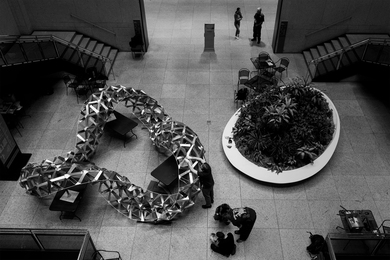
The Boston Globe’s Mark Feeney chronicles MIT’s adaptive reuse of the historic Metropolitan Warehouse into the new home of the School of Architecture and Planning. “As spaces, our studios used to be a lot more like labs, but now they are grand and full of light and celebratory in a way that hopefully enables better work,” says Prof. Ana Miljački, Head of the Department of Architecture.  

The Atlantic

MIT researchers have found that lower birth rates are associated with higher growth in Gross Domestic Product globally, writes The Atlantic’s Idrees Kahloon. “[P]erhaps more important than the observed correlation is the authors’ proposed explanation: that when prime-age workers become scarce, companies adapt by developing productivity-boosting technology,” notes Kahloon.  

The Boston Globe

Prof. Robert Langer, cofounder of Moderna, speaks to The Boston Globe’s Marin Wolf and Jonathan Saltzman about the company’s successful results of a personalized messenger RNA vaccine in a late-stage trial to treat melanoma. “So far, the only proof is with melanoma, but it’s a stunning example of what can be done,” says Langer. “I don’t see any reason why it wouldn’t work with other types of cancer.” 

NPR

Prof. Erin Kara speaks to NPR’s Ari Daniel about how the fastest star ever observed in the galaxy, located next to the Sagittarius A* black hole, experiences how space and time are distorted by the black hole. “This is a really exciting result," says Kara. "It kind of sets the stage in the next decade to make these kind of unprecedented measurements of black holes.” 

STAT

In a STAT opinion piece, Arya Rao, a candidate in the Harvard/MIT MD-PhD program, and Marc Succi write about how AI impacts clinical reasoning. “[C]linical reasoning and model reasoning are not the same thing,” Rao and Succi explain. “AI not only lacks this hidden framework and data repository for learning, but it arrives at conclusions using a fundamentally different method.” 

Boston Business Journal

In a “radical example of adaptive reuse” and a reimagining of a historic Cambridge landmark, MIT has transformed the Metropolitan Storage Warehouse into the new home of the School of Architecture and Planning, bringing together MIT’s architecture and design programs into one connected academic hub, reports Boston Business Journal reporter Maya Shavit. “There will be new installations and new manifestations of our students’ creativity every single week,” explains Prof. John Ochsendorf. “That’s unpredictable and messy, but it’s also part of the fun of being at a place like MIT where people are constantly inventing the future.”

Financial Times

Financial Times reporter Martin Wolf spotlights Institute Prof. Daron Acemoglu’s latest book, “What Happened to Liberal Democracy?”, which he notes is "timely and thought-provoking,” and "an important call to arms.” In the book, Acemoglu explores his "grand idea of ‘working-class liberalism,’” writes Wolf. “This concept, he states, is built on experimentation and the freedoms of association and expression, is suspicious of excessive power, uses redistribution, allows the less fortunate to participate more fully, values growth, attempts to provide good jobs for everybody and values community, trust and the sharing of useful knowledge.”

Community Updates

Featured Multimedia

Video thumbnail

What if operating an excavator could be faster, easier, and more intuitive? MIT engineers have developed a new controller designed to make digging simpler—and help train operators faster. See how this new technology could change the way we dig.

Video thumbnail

MIT researchers uncovered a new cyberattack that can bypass some of the latest security defenses built into modern computer processors. The researchers explain how the attack works — and what it reveals about potential vulnerabilities in today’s hardware.

Video thumbnail

Meet Paula Hammond, MIT Institute Professor and Dean of the School of Engineering—the first woman and first Black scholar to lead MIT's Department of Chemical Engineering. Discover how her pioneering research in nanotechnology and ovarian cancer has shaped her career, the barriers she broke along the way, and what it means to change what leadership looks like in STEM.

Video thumbnail

For 75 years, MIT Lincoln Laboratory has developed technology to help keep the nation safe. Founded in 1951, the Laboratory tackles critical national security challenges through long-term research, rapid system prototyping, and demonstration. It also works with industry to transition new concepts and technologies into systems ready for development and deployment.

Video thumbnail

MIT engineers have designed a robot that can fly through the air, dive underwater to swim, then flap back into flight—much like a diving bird. The breakthrough could pave the way for a new class of aerial-aquatic vehicles for ocean exploration.

Video thumbnail

Researchers at MIT have developed injectable "mini livers" designed to temporarily take over essential liver functions, offering a potential new option for people with liver failure who are waiting for a transplant—or who aren't eligible for one at all.

Video thumbnail

Some of the most important things in life feel ordinary, until you stop and think about what makes them possible. A cure. A car. A comet. Someone right now is chasing answers to questions we haven't even asked yet. From medicine to infrastructure to breakthroughs we can't yet imagine, science touches every part of daily life because someone followed their curiosity.

More News