Skip to content ↓

📬 Want a dose of MIT in your inbox? Subscribe to the MIT Daily and/or MIT Weekly newsletters.

Top News

Looking for audio? Listen to the MIT News podcast

Recent Highlights

More MIT News articles

In the Media

Boston Business Journal

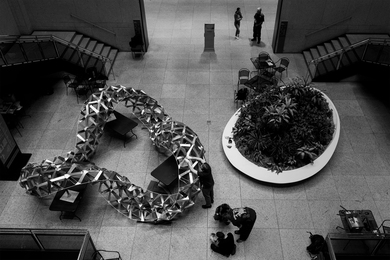
In a “radical example of adaptive reuse” and a reimagining of a historic Cambridge landmark, MIT has transformed the Metropolitan Storage Warehouse into the new home of the School of Architecture and Planning, bringing together MIT’s architecture and design programs into one connected academic hub, reports Boston Business Journal reporter Maya Shavit. “There will be new installations and new manifestations of our students’ creativity every single week,” explains Prof. John Ochsendorf. “That’s unpredictable and messy, but it’s also part of the fun of being at a place like MIT where people are constantly inventing the future.”

Financial Times

Financial Times reporter Martin Wolf spotlights Institute Prof. Daron Acemoglu’s latest book, “What Happened to Liberal Democracy?”, which he notes is "timely and thought-provoking,” and "an important call to arms.” In the book, Acemoglu explores his "grand idea of ‘working-class liberalism,’” writes Wolf. “This concept, he states, is built on experimentation and the freedoms of association and expression, is suspicious of excessive power, uses redistribution, allows the less fortunate to participate more fully, values growth, attempts to provide good jobs for everybody and values community, trust and the sharing of useful knowledge.”

Interesting Engineering

Prof. Dennis Whyte and Prof. Andrew Lo have built a framework to mitigate the economic challenges of fusion power, writes Interesting Engineering’s Ameya Paleja. “While there are multiple approaches to building a nuclear fusion facility, Whyte and colleagues believe that at the end of the day, the facility should be in a position to generate more money that has gone in to building and operating it, otherwise it won’t last for long,” writes Paleja. 

Forbes

Prof. Paul Osterman speaks to Forbes’ Courtney Connley-Hampton about his new book “Disposable Workers: The Transformation of Employment,” and how AI may exacerbate the disposable worker trend. “Your only source of power in the labor market is your human capital, your skill,” says Osterman. “Get as much skill as you can. You may end up having to change jobs and move around, but if you have valuable skills, that protects you.” 

USA Today

Dr. Joseph Sakran and Dr. Rebecca Stone, contributors to USA Today, highlight the Outsmart Ovarian Cancer initiative launched across cancer centers and institutions, including MIT. Outsmart Ovarian Cancer “has a single goal: making concurrent salpingectomy, the removal of the fallopian tubes during another planned post-reproductive operation, a routine and reimbursable part of care rather than an aspirational idea,” Sakran and Stone write.  

The New York Times

Ben Armstrong, executive director of the MIT Industrial Performance Center, speaks to The New York Times reporter Jack Ewing about humanoid robots being deployed to work in car factories. “Humanoids are a million-dollar solution to a one-hundred-dollar problem,” says Armstrong. “The prospect of humanoids to change the game in automotive is quite small.” 

The Minnesota Star Tribune

In an article by The Minnesota Star Tribune’s Emma Nelson, Prof. David Autor discusses low sentiment among middle-class Americans regarding the U.S. economy. “There’s a belief that if you follow the rules, if you go to school and pay your taxes and pay your bills and send your kids to college and whatever, that you’re supposed to do better than the generation before you,” says Autor. “When that does not happen is “part of when [people] feel like society’s not functioning well.” 

Forbes

Forbes’ “50 Over 50” list spotlights four MIT faculty leading innovation in science and technology: Prof. Paula Hammond, dean of the MIT School of Engineering; Prof. Dina Katabi; Prof. Nergis Mavalvala, dean of the MIT School of Science; and Aude Oliva, director of MIT-IBM Computing Research Lab. The 50 “science and technology standouts on this list are advancing how we use AI, fight osteoporosis and deploy clean energy.”  

WCVB

MIT researchers have discovered space matter that has been ‘missing’ since the 1990s using Fast Radio Bursts, individual flashes of radio waves traveling through space and coming from the distant universe, reports WCVB 5’s Cindy Fitzgibbon. “The takeaway of the study is that by discovering the distribution of the missing matter around galaxies, we have found evidence for strong activities in galaxies,” says graduate student Haochen Wang, a co-author on the study. “In other words, galaxies are busier and messier than we thought.” 

Associated Press

Associate Prof. Taha Choukhmane speaks to Associated Press reporter Adriana Morga about explores the growing trend of consumers using AI for financial guidance, and his recommendation that AI be used as a tool in combination with other trusted sources. “I would encourage people to use AI to explain and define,” says Choukhmane. “If you’re interested in knowing what the stock market is, what the difference between a mutual fund and an index fund is, using AI to explain these concepts can be very useful because it can empower people to get the most out of these methods.”

GBH

Prof. Danielle Wood joins Edgar B. Herwick III, host of GBH’s “The Curiosity Desk,” to discuss the growing problems posed by space junk, and how space technology helps support our critical infrastructure. “Technology from space helps make life safer on Earth, supports our weather forecasting [and] our daily transportation. All the technology that lets us get deliveries and Uber—that's all coming from space,” says Wood. “We definitely need space to be safe—to keep our lives safe.” 

CNN

Prof. Raphael Zufferey and his research group developed a winged robot that can swim underwater and fly through the air like a diving bird and “could one day be used to monitor and ultimately help protect the ocean,” reports Tom Page for CNN. “We’re really trying to understand better how birds do this,” says Zufferey. “The other reason we’re doing this is we’re hoping that this becomes (a) future tool for oceanography.” 

Fox Business

Fox Business’ Eric Revell highlights MIT being named to the top five of LinkedIn’s list of the top colleges that give graduates the strongest career edge. “The report uses LinkedIn data to rank colleges based on five categories: job placement, internships and recruiter demand, career success, network strength and knowledge breadth,” writes Revell.  

Community Updates

Featured Multimedia

Video thumbnail

Meet Paula Hammond, MIT Institute Professor and Dean of the School of Engineering—the first woman and first Black scholar to lead MIT's Department of Chemical Engineering. Discover how her pioneering research in nanotechnology and ovarian cancer has shaped her career, the barriers she broke along the way, and what it means to change what leadership looks like in STEM.

Video thumbnail

For 75 years, MIT Lincoln Laboratory has developed technology to help keep the nation safe. Founded in 1951, the Laboratory tackles critical national security challenges through long-term research, rapid system prototyping, and demonstration. It also works with industry to transition new concepts and technologies into systems ready for development and deployment.

Video thumbnail

MIT engineers have designed a robot that can fly through the air, dive underwater to swim, then flap back into flight—much like a diving bird. The breakthrough could pave the way for a new class of aerial-aquatic vehicles for ocean exploration.

Video thumbnail

Researchers at MIT have developed injectable "mini livers" designed to temporarily take over essential liver functions, offering a potential new option for people with liver failure who are waiting for a transplant—or who aren't eligible for one at all.

Video thumbnail

Some of the most important things in life feel ordinary, until you stop and think about what makes them possible. A cure. A car. A comet. Someone right now is chasing answers to questions we haven't even asked yet. From medicine to infrastructure to breakthroughs we can't yet imagine, science touches every part of daily life because someone followed their curiosity.

Video thumbnail

A baseball-sized sensor could help detect dangerous chemical threats before they spread. Developed by MIT Lincoln Laboratory, the "TOSSIT" device can quickly identify hazardous vapors and aerosols, helping warn service members and first responders of potential danger.

More News